
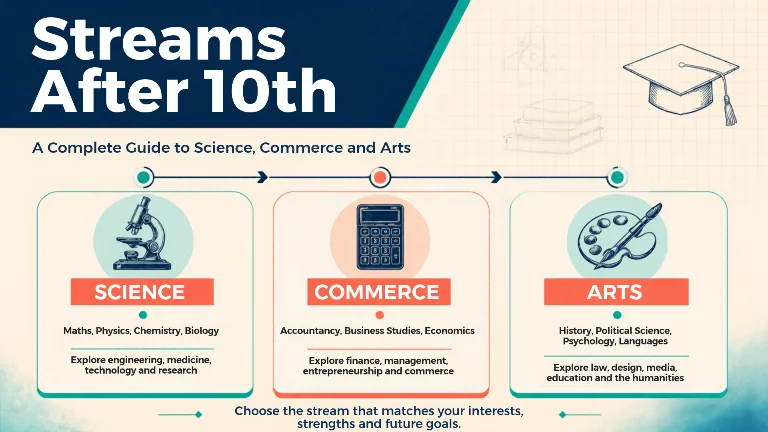
Choosing a stream after Class 10 starts with understanding a student’s interests, strengths and future course requirements. Science may suit learners drawn to experiments, technology or healthcare; Commerce may appeal to students interested in business, accounts and finance; and Arts or Humanities may fit those curious about society, history, languages, psychology and creative fields. Compare actual subject combinations offered by schools before deciding.
The familiar labels—Science, Commerce and Arts—are useful starting points, but they are not identical across every school or education board. The subjects a student selects in Classes 11 and 12 can affect eligibility for certain degree programmes and entrance examinations. A careful choice keeps suitable options open without forcing a student into a stream only because of marks, family expectations or friends.
Why Is Choosing the Right Stream After 10th Important?
Classes 11 and 12 introduce more specialised subjects and a different pace of learning. Students move from broad school-level topics to deeper study in selected areas. The right combination can make learning more engaging and prepare a student for further education. A poor fit can create avoidable stress, even when the student has the ability to succeed.
A stream should be selected by looking at three connected factors: interest (what the student enjoys learning), aptitude (the skills and ways of thinking that come more naturally) and eligibility (the subjects required for future courses). Marks are useful evidence, but one examination result should not decide a student’s entire direction.
What Are the Main Streams Available After Class 10?
Most schools present three broad academic pathways—Science, Commerce and Arts/Humanities. Some schools also offer vocational or skill-based courses, and subject combinations may allow students to mix selected electives. Availability depends on the school, board rules and local admission requirements.
| Stream | Common Class 11–12 subjects | Often suits students interested in |
| Science (PCM) | Physics, Chemistry, Mathematics, English and an elective | Engineering, technology, architecture-related pathways, physical sciences, mathematics and computing |
| Science (PCB) | Physics, Chemistry, Biology, English and an elective | Medicine-related pathways, life sciences, biotechnology, pharmacy-related study and health sciences |
| Science (PCMB) | Physics, Chemistry, Mathematics, Biology and language / other required subjects | Students who want to retain both maths- and biology-related options and can manage the workload; offered only by some schools |
| Commerce | Accountancy, Business Studies, Economics, Mathematics or Applied Mathematics / other electives | Accounting, finance, business, economics, management, entrepreneurship and banking |
| Arts / Humanities | History, Political Science, Geography, Psychology, Sociology, Economics, languages, fine arts or other electives | Law, civil services preparation, social sciences, journalism, design, education, public policy and creative fields |
| Vocational / Skill-based | Subjects such as IT, retail, tourism, healthcare, media, agriculture or other applied skills | Practical, occupation-linked learning and specific technical or service-sector pathways |
1. What Is the Science Stream and Who Should Choose It?
The Science stream focuses on understanding the natural and physical world through concepts, observation, experiments, calculations and evidence. Common combinations include Physics, Chemistry and Mathematics (PCM), or Physics, Chemistry and Biology (PCB). Some institutions offer both Mathematics and Biology (PCMB), but this combination can be demanding and is not available everywhere.
Which subjects are studied in Science?
- Physics: motion, energy, electricity, waves and the principles behind physical systems.
- Chemistry: substances, reactions, materials and the structure of matter.
- Mathematics: algebra, calculus-related foundations, geometry, statistics and logical problem-solving.
- Biology: living organisms, human and plant systems, genetics, ecology and life processes.
- Additional subjects may include Computer Science, Informatics Practices, Physical Education, a language or a skill subject, depending on the school.
What careers can Science lead to?
Depending on the subjects selected, entrance requirements and later qualifications, Science can support pathways such as engineering, medicine, dentistry, nursing, pharmacy, biotechnology, agriculture, veterinary science, research, data and computing, environmental science and other technical or health-related fields. Not every course is open to every Science combination. For example, some programmes require Biology, some require Mathematics, and others specify additional eligibility conditions.
Who may be a good fit for Science?
- Students who are genuinely curious about how things work and enjoy asking scientific questions.
- Learners who are willing to practise mathematical reasoning, experiments, diagrams and problem-solving regularly.
- Students whose possible future courses require particular Science subjects.
Do not choose Science only because it is considered prestigious or because a student scored well in Class 10. Review the actual Class 11 workload and subject prerequisites first.
2. What Is the Commerce Stream and Who Should Choose It?
Commerce explores how businesses, markets and financial systems work. Students learn how organisations record transactions, make decisions, manage resources and respond to economic conditions. Common subjects include Accountancy, Business Studies and Economics. Mathematics or Applied Mathematics may be available as an elective, depending on the school.
Which subjects are studied in Commerce?
- Accountancy: recording, classifying and interpreting financial transactions.
- Business Studies: business organisations, management, marketing and operations.
- Economics: markets, production, consumption, money, public policy and economic systems.
- Mathematics / Applied Mathematics or Statistics: quantitative reasoning useful in several business and finance pathways.
- Other electives may include Entrepreneurship, Informatics Practices, Computer Science, a language or a skill subject.
What careers can Commerce lead to?
Commerce can provide a foundation for degrees and professional routes in accounting, finance, banking, economics, business administration, management, taxation, company-related work, marketing, entrepreneurship and analytics. Examples of later pathways include B.Com, BBA, economics programmes and professional qualifications such as CA, CMA or CS, subject to the relevant body’s current eligibility and examination rules.
Who may be a good fit for Commerce?
- Students interested in how businesses earn, spend, invest and grow.
- Learners who enjoy working with numbers, interpreting information or understanding markets and organisations.
- Students curious about entrepreneurship, finance, management, accounting or economics.
Commerce is not simply an ‘easy’ alternative to Science. Accountancy and Economics require regular practice, careful reading and clear conceptual understanding. Check whether Mathematics is needed for the specific college course or career the student may later pursue.
3. What Is the Arts or Humanities Stream and Who Should Choose It?
Arts, commonly called Humanities in many schools, studies people, societies, cultures, ideas, institutions and creative expression. It develops reading, writing, interpretation, research, communication and critical-thinking skills. Subject options vary widely, so students should examine the electives available at their preferred school.
Which subjects are studied in Arts/Humanities?
- History: people, events, societies and change over time.
- Political Science: government, constitutions, political ideas and public institutions.
- Geography: places, environment, resources, population and spatial patterns.
- Psychology: behaviour, thought, emotion and mental processes.
- Sociology: social groups, culture, institutions and social change.
- Other options may include Economics, English or other languages, Fine Arts, Legal Studies, Home Science, Physical Education and skill subjects.
What careers can Arts/Humanities lead to?
Humanities can support further study and careers in law, journalism, media, teaching, psychology-related fields (with the required higher qualifications), social work, public administration, civil services, design, communication, international relations, public policy, research, languages and the arts. Some regulated professions require specific degrees, supervised training or licensing; a Class 12 stream alone does not qualify someone to practise them.
Who may be a good fit for Arts/Humanities?
- Students who enjoy reading, writing, discussion, research or understanding people and society.
- Learners interested in history, politics, culture, languages, psychology, Gujarati Gujarati tuition in Ahmedabad , geography or creative work.
- Students who want to build strong communication, analysis and interpretation skills.
Arts is not a ‘lesser’ stream. It includes rigorous subjects and can lead to demanding professional and academic pathways. Choose it because the subjects fit the student—not because of assumptions about marks or difficulty.
How Do Science, Commerce and Arts Compare?
| Decision factor | Science | Commerce | Arts / Humanities |
| Main focus | Scientific concepts, experiments and quantitative reasoning | Business, finance, accounting and economic systems | People, society, history, ideas and creative expression |
| Typical learning style | Concept application, calculations, practical work and problem-solving | Numerical practice, case studies, financial records and business analysis | Reading, writing, discussion, interpretation and research |
| Possible future study areas | Engineering, health sciences, computing, pure sciences and related fields | Commerce, finance, accounting, economics and management | Law, social sciences, media, public policy, education and creative disciplines |
| Check before choosing | Whether PCM, PCB or another combination is required for the intended course | Whether Mathematics is required or recommended for the target programme | Whether a specific subject is required for the intended degree or entrance test |
Can Students Choose Vocational or Skill-Based Courses After 10th?
Yes. Depending on the state, board, institution and admission rules, students may consider diploma programmes, vocational subjects, ITI courses, polytechnic pathways or other skill-based training after Class 10. Areas can include engineering trades, information technology, healthcare support, tourism, retail, media, agriculture, design and other applied fields.
These options can provide structured practical learning and may lead to employment, apprenticeships or further study. Before enrolling, verify the institution’s recognition, course duration, fees, practical training, progression routes and the qualification awarded. Do not assume that every certificate has the same value or grants entry to a degree programme.
How Should You Choose the Right Stream After 10th? A Seven-Step Guide
Start with the student’s interests.
Ask which subjects, projects and activities the student chooses voluntarily. Identify topics that create curiosity, not only those in which marks are high.
Review strengths and learning habits.
Look at performance across subjects, the student’s comfort with numerical work, reading, writing, experiments and independent study. Discuss patterns with teachers.
Explore possible careers without locking into one.
Make a shortlist of broad areas—such as healthcare, engineering, business, law, design or public service—and check the Class 12 subjects and later qualifications each requires.
Check subject combinations at actual schools.
Ask for the current Class 11 subject list, compulsory subjects, elective rules, minimum marks, seat availability and whether combinations such as PCMB or Mathematics with Commerce are offered.
Understand the workload and support needed.
Compare the amount of practice, reading, practical work, projects and exam preparation. Consider travel, timetable, learning support and realistic study time.
Talk to informed people and verify requirements.
Speak with subject teachers, school counsellors and professionals where possible. Check official university, entrance-exam and professional-body eligibility pages for the courses being considered.
Make a decision with the student, then review it calmly.
Discuss the options and reasons. Avoid choosing only to follow friends or meet outside expectations. Ask the school about its subject-change deadline and policy before finalising admission.
Which Stream Is Best for Students Who Are Unsure About Their Career?
There is no universally best stream. If a student is undecided, begin by identifying subjects they enjoy and the future courses they may want to keep open. Then check whether those courses require Mathematics, Biology, a particular language or another Class 12 subject. A broad combination may preserve more options, but it should remain manageable and be available at the chosen school.
Students should not assume that one stream permanently closes every other career. Many degree programmes accept students from more than one stream, while certain professional courses have strict subject prerequisites. Eligibility varies by institution and year, so verify it before choosing.
What Should Parents Avoid When Helping a Child Choose a Stream?
- Do not treat Science as automatically more valuable or Arts as a fallback.
- Do not make the decision only on the basis of Class 10 percentage or one subject’s marks.
- Do not ask a student to copy a friend’s choice or fulfil an adult’s untested career preference.
- Do not rely on old social-media lists of careers or outdated eligibility rules.
- Do not enrol before confirming the school’s exact subject combination, fees, recognition and change-of-subject policy.
- Do not promise that a particular stream guarantees a job, salary, college seat or professional qualification.
How Can Jishnu Tattva Support Students After Class 10?
Jishnu Tattva can be positioned as an education-support resource for students and families planning the transition from Class 10 to Classes 11 and 12. Students may use the platform to explore relevant academic support and connect with tutors for subjects they need help understanding. The most useful starting point is to identify the student’s board, chosen stream, subjects, current learning needs and preferred study schedule.Contact Us | Jishnutattva
For example, a student taking PCM may want support in Physics or Mathematics Maths tutors in Ahmedabad; a PCB student may need help with Biology or Chemistry; a Commerce student may seek Accountancy or Economics guidance; and a Humanities student may want support with History, Political Science, Psychology or English. Tutor availability and subject coverage should be confirmed before making an arrangement.
Need subject support for Classes 11–12? Explore relevant learning support with Jishnu Tattva and share the student’s stream, board, subjects and preferred schedule.Share your tuition requirement with Jishnu Tattva
Editorial and Accuracy Notes
Subject combinations, school admission criteria, entrance-exam requirements and professional eligibility rules can change. This article is general guidance, not an admission or career-eligibility ruling. Before publishing, verify any course-specific examples against the latest official information from the relevant board, university, entrance authority or professional body. Do not add a claim that Jishnu Tattva provides formal career counselling unless that service is actually available.