
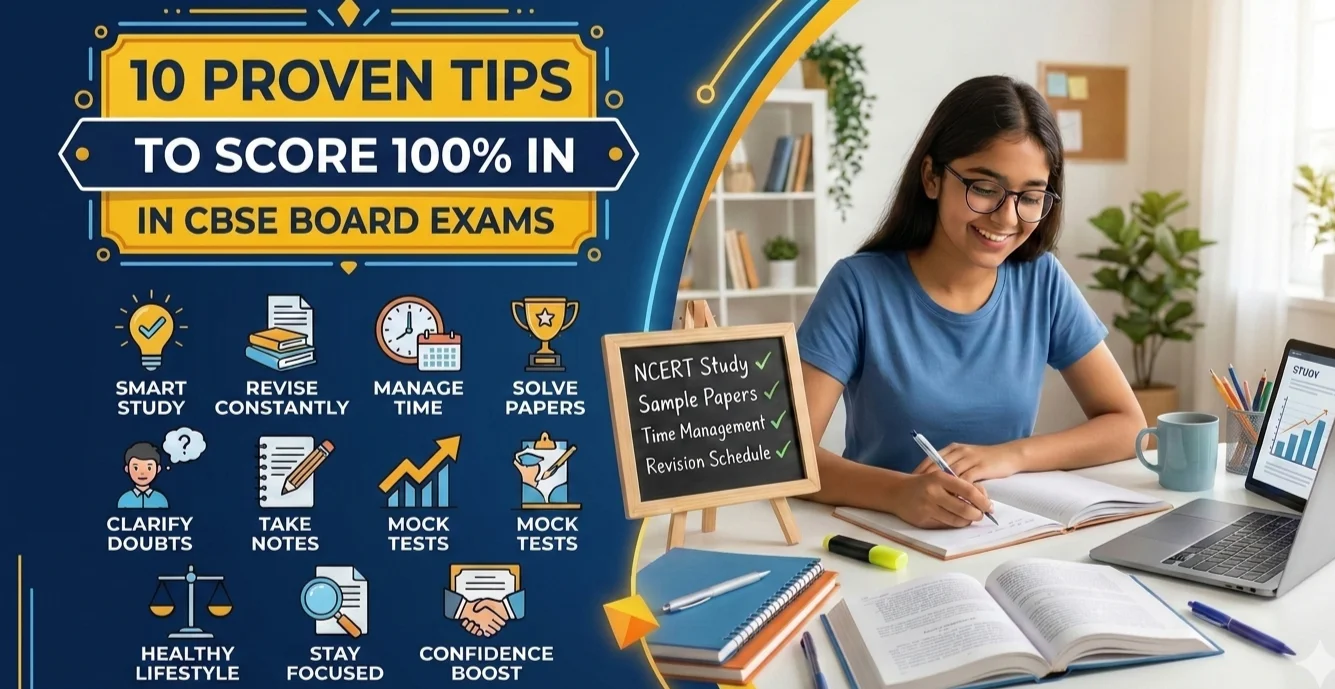
To score 100 percent in CBSE board exams, start by mastering the latest NCERT textbooks line by line, understanding chapter-wise weightage, and practising competency-based and case-study questions regularly. Combine active recall, official CBSE sample papers, strict 3-hour mock tests, and step-by-step answer presentation aligned with the official marking scheme. Consistent revision and timely doubt-clearing with experienced teachers or tutors ensure zero conceptual gaps before exam day.
Securing a perfect score in Class 10 or Class 12 CBSE board exams is not about studying 14 hours a day or memorising multiple reference guides. The Central Board of Secondary Education (CBSE) designs its question papers to test conceptual clarity, analytical application, and structured presentation. Students who score 99 to 100 percent treat the syllabus systematically—focusing on official curriculum blueprints, error logs, and examiner-friendly answer sheets.
What Does It Really Take to Score Full Marks in CBSE Exams?
A 100 percent score in a CBSE subject requires two things working together: flawless conceptual accuracy in your internal assessments or practicals (20 or 30 marks) and step-wise precision in the written theory paper (80 or 70 marks). Because CBSE follows a step-marking scheme, even a small missing unit in Physics, an unlabelled diagram in Biology, or a skipped theorem statement in Mathematics can cost half a mark.
For example, if a Class 10 student solves a quadratic equation correctly on the final line but skips the intermediate factorisation step, the examiner cannot award full marks for that question. Similarly, in Class 12 Humanities or Commerce subjects like Economics and Business Studies, top scorers use exact NCERT headings and support every analytical point with a brief diagram or flowchart.
The main advantages of following a structured board strategy are lower exam anxiety, predictable time management during the 3-hour window, and high accuracy across MCQs, assertion-reasoning, and long-answer questions.
What Are the 10 Proven Tips to Score 100 Percent in CBSE Board Exams?
1. How do you decode the latest CBSE syllabus and chapter weightage?
Before opening a textbook, download the current academic year’s curriculum document from the official CBSE academic website (cbseacademic.nic.in). Every unit carries a fixed mark allocation, and knowing which chapters hold the highest weightage prevents you from spending excessive time on deleted or low-yield topics.
- Print the subject-wise syllabus and pin it above your study desk for daily tracking.
- Highlight high-weightage units (such as Calculus in Class 12 Maths, Life Processes and Light in Class 10 Science, or Macroeconomics in Class 12) for priority study.
- Cross-check rationalised topics with your school teacher or home tutor so you do not prepare excluded exercises.
2. Why should NCERT textbooks be your primary study bible?
Over 85 to 90 percent of CBSE board exam questions—including direct definitions, solved examples, and assertion-reason statements—are framed directly from NCERT textbooks and NCERT Exemplar problems. Jumping to bulky reference books before finishing NCERT often confuses students rather than helping them.
Read every chapter active-style: underline key terms, solve all in-text blue-box questions, and work through every Miscellaneous Exercise at the back of the chapter. In subjects like Chemistry, Biology, and Social Science, examiners frequently lift one-mark MCQs from figure captions, summary boxes, and footnotes.
3. How do you prepare for competency-based and case-study questions?
Recent CBSE paper patterns allocate a significant portion of marks (up to 50 percent in Classes 10 and 12) to competency-focused questions, including MCQs, case-based passages, source-based integrated questions, and assertion-reasoning items. Rote memorisation does not work for these sections.
- Ask "why" and "how" after learning every scientific law, mathematical formula, or historical event.
- Practise NCERT Exemplar problems and official CBSE Question Banks to get comfortable with real-life application scenarios.
- For Assertion-Reason questions, first verify whether each statement is independently true before checking if Reason (R) is the correct explanation of Assertion (A).
4. How should you build custom revision notes, formula sheets, and mind maps?
Handwritten notes written in your own words are far more effective during the final 15 days before exams than printed coaching handouts. Condense every 20-page chapter into a single 1-to-2-page summary sheet containing only core definitions, formulas, dates, reactions, and common exceptions.
Keep a dedicated A4 notebook or flashcard deck for:
- Mathematics & Physics: Formulas, standard derivatives/integrals, SI units, sign conventions, and ray/circuit diagrams.
- Chemistry: Named organic reactions, periodic trends, balanced chemical equations, and colour changes of compounds.
- Social Science, Commerce & Humanities: Chronological timelines, constitutional articles, map locations, and exact keyword headings.
5. What is the right way to solve CBSE Sample Papers (SQPs) and Past Year Questions (PYQs)?
Solving the last 5 to 7 years of Previous Year Question Papers (PYQs) alongside the current year’s official CBSE Sample Question Paper (SQP) reveals recurring themes and question framing styles. However, simply reading the solutions does not build exam stamina.
- Attempt at least 5 to 8 full-length papers per subject sitting at a desk for 3 continuous hours (preferably between 10:30 AM and 1:30 PM to match actual board exam timings).
- Use the initial 15-minute reading time (10:15 AM to 10:30 AM) strictly to read case-study passages, choose between internal choices (OR questions), and mentally outline formulas.
- Maintain an Error Log Notebook after every mock paper to record whether marks were lost due to a concept gap, calculation mistake, or poor time management.
6. How can you master the official CBSE Marking Scheme and answer presentation?
CBSE releases official Marking Schemes alongside its sample papers showing the exact value points examiners look for when checking copies. A 95-percent student and a 100-percent student often know the same facts; the 100-percent scorer presents those facts so clearly that the evaluator cannot deduct a single half-mark.
- Write answers in crisp bullet points rather than dense, unbroken paragraphs (especially in Science, Social Science, and Business Studies).
- Underline key technical terms, dates, and final numerical answers with a pencil and scale.
- Draw neat, proportionate diagrams, flowcharts, and tables wherever relevant—even if the question does not explicitly ask for a diagram, a labelled sketch reinforces clarity.
- Adhere strictly to word limits: 30–50 words for 2-mark questions, 50–80 words for 3-mark questions, and 80–120 words for 5-mark questions.
7. How do you manage time across Sections A to E during the 3-hour exam?
Many well-prepared students lose 5 to 8 marks in Mathematics, Accountancy, or Physics simply because they spend too much time on early 1-mark MCQs and rush through 5-mark long answers at the end. Follow a structured section-wise pacing plan so you finish the paper in 165 minutes and reserve the final 15 minutes for revision.
- Never spend more than 2 minutes on a single 1-mark MCQ; if stuck, leave space and return to it during the final 15 minutes.
- Write the question number clearly in the centre or left margin, matching the exact numbering in the question paper.
- During the last 15 minutes, verify that all sub-parts of multi-part questions are answered, units (cm², Ω, J, ₹) are written, and roll numbers/question numbers are double-checked.
8. Why must you secure full marks in Internal Assessments, Practicals, and Projects?
Scoring 100/100 overall is impossible without securing 20/20 in Internal Assessments (Class 10 and non-practical Class 12 subjects) or 30/30 in Practical Exams (Class 12 Physics, Chemistry, Biology, Accountancy, Computer Science, etc.). Many students treat project files and viva sessions casually until the last week.
Submit neat, original project files and lab manuals well before school deadlines. For Class 12 viva voce exams, external examiners primarily ask questions based on the project topic you chose and the core theory behind the experiments in your lab manual.
9. How do spaced repetition and the 3-tier revision cycle prevent forgetting?
Studying a chapter once in August and opening it again in January guarantees you will forget 70 percent of the details. Top CBSE scorers follow a 3-Tier Spaced Revision Cycle:
- Cycle 1 (Day 2 after learning): Quick 15-minute active recall and notebook review without looking at the textbook.
- Cycle 2 (Day 14): Solve 15–20 mixed topic questions, Exemplar problems, and previous year questions from that chapter.
- Cycle 3 (Monthly & Pre-Boards): Full-unit timed test combined with your 1-page summary sheet and Error Log review.
10. When should you clear doubts and maintain peak health before boards?
Letting small doubts pile up across chapters creates panic during Pre-Boards. Whether you study independently, attend school classes, or work with a home tutor, resolve every conceptual doubt within 48 hours of encountering it. Along with academic rigour, sleep 7 to 8 hours nightly—especially in the month leading up to February/March exams—so your memory consolidation and calculation speed stay sharp.
How Should Strategy Differ Across Core CBSE Subjects?
Every CBSE subject tests a distinct skill set. Use the subject-wise blueprint below to tailor your daily practice and answer-writing format.
| Subject Group | What Examiners Look For in a 100/100 Answer Sheet | Daily Practice Focus |
|---|---|---|
| Mathematics (Class 10 & 12) | Step-wise working, stated formulas/theorems in brackets, rough work in a neat right-hand margin, and boxed final answers with units. | Solve 15–20 NCERT & Exemplar problems daily; write every step without skipping mental jumps. |
| Science (Physics, Chemistry, Biology) | Exact technical keywords, balanced chemical equations with physical states (s), (l), (g), (aq), neat pencil-drawn ray/biological diagrams, and SI units. | Practice numericals with given data/formula/substitution layout; revise reaction & diagram sheets. |
| Social Science & Humanities | Structured bullet points (3 points for 3 marks, 5 points for 5 marks) with bold sub-headings, historical dates, and accurate map-work labelling. | Read NCERT chapters line-by-line; create cause-and-effect tables and practise map pointing weekly. |
| Commerce (Accountancy, Business Studies, Economics) | Proper ledger/balance sheet formats, narration below journal entries, working notes clearly referenced, and labelled economic curves. | Practise timed ledger problems to improve calculation speed; use flowcharts for Business Studies case studies. |
| Languages (English, Hindi, Sanskrit, Gujarati) | Strict adherence to CBSE box/letter/analytical paragraph formats, zero grammatical/spelling errors, and direct textual references in literature answers. | Memorise official writing-section layouts; write 2 timed comprehension & literature answers twice a week. |
For targeted one-to-one board preparation, explore Maths tutors in Ahmedabad and compare verified CBSE educators by class, locality, and topic.
For language scoring support, grammar accuracy, and writing practice, see Gujarati tuition in Ahmedabad for relevant tutor options.
How Should You Allocate the 3 Hours (180 Minutes) Inside the Exam Hall?
Having a fixed time-allocation plan prevents last-minute rushing. Below is a practical 180-minute breakdown for a standard 80-mark CBSE theory paper divided into five sections:
- Reading Time (15 Minutes — 10:15 AM to 10:30 AM): Scan the entire paper, mark the easiest internal choices (OR questions), and pre-read the Section E case-study passages before writing begins.
- Section A (20 MCQs & Assertion-Reason — 1 Mark each): Complete within 30 Minutes (1.5 minutes per question). Write both the option letter (a)/(b)/(c)/(d) and the full option text.
- Section B (5 Very Short Answer Questions — 2 Marks each): Complete within 20 Minutes (4 minutes per question; 2–3 crisp points).
- Section C (6 Short Answer Questions — 3 Marks each): Complete within 35 Minutes (5–6 minutes per question; 3–4 structured points or diagram).
- Section D (4 Long Answer Questions — 5 Marks each): Complete within 50 Minutes (12 minutes per question; detailed step-by-step derivation, diagram, or 5-point analytical answer).
- Section E (3 Case-Based / Source-Based Questions — 4 Marks each): Complete within 30 Minutes (10 minutes per case study).
- Final Review & Verification: Reserve the last 15 Minutes to check unattempted sub-parts, calculation accuracy, units, diagram labels, and underlining of keywords.
How Can You Audit Your Board Exam Readiness Monthly?
Use this 5-point self-assessment scorecard every month from October to January to measure your preparation objectively. Score yourself from 1 (needs urgent attention) to 5 (exam-ready) across each parameter.
| Readiness Factor | What to Observe in Your Preparation | Target Score |
|---|---|---|
| NCERT Mastery | Can solve all in-text, back-exercise, and Exemplar questions without hints | 1–5 |
| Concept & Case Clarity | Scores 90%+ in unseen competency-based and assertion-reason questions | 1–5 |
| Answer Presentation | Uses official CBSE marking scheme steps, bullet points, units, and neat diagrams | 1–5 |
| 3-Hour Speed & Stamina | Completes an 80-mark sample paper in 165 minutes with 15 minutes left to review | 1–5 |
| Error Log Reduction | Does not repeat earlier calculation, sign, or silly reading mistakes in new tests | 1–5 |
Example: If a Class 10 student scores 5/5 in NCERT Mastery but 2/5 in 3-Hour Speed & Stamina, the focus for the next four weeks should shift from passive reading to timed 3-hour mock paper writing.
What Should Your Final 4-Week Pre-Board Revision Plan Look Like?
Instead of starting new reference books in the final month before CBSE board exams, follow a structured 4-week consolidation plan:
- Week 1: Complete a thorough revision of weak and high-weightage chapters using your NCERT textbook and Error Log Notebook.
- Week 2: Solve 3 full-length CBSE Sample Question Papers per subject under strict 3-hour timed conditions and self-evaluate using the official CBSE Marking Scheme.
- Week 3: Focus on rapid revision of formula sheets, organic reactions, historical timelines, map work, and writing-section formats.
- Week 4: Review one-page summary notes, get 8 hours of sleep daily, verify admit card and stationery requirements, and maintain calm confidence.
How Can Jishnu Tattva Help You Prepare for CBSE Board Exams?
Jishnu Tattva is an educational directory and tutor-matching platform where students and parents can share their class, board (CBSE, ICSE, GSEB, IB), specific subjects, locality, and preferred schedule to connect directly with experienced home tutors and coaching academies. Rather than sifting through unverified listings, families can find subject specialists who understand the latest CBSE competency-based pattern and marking scheme.
Whether you need focused doubt-solving in Class 10 Mathematics and Science or specialist guidance for Class 12 Physics, Chemistry, Accountancy, or Economics, personalised one-to-one attention helps bridge the gap between a 90 percent score and a perfect 100 percent.
Looking for CBSE Home Tutors or Coaching Academies? Share your tuition requirement with Jishnu Tattva and connect with qualified educators for your board exam preparation.